Master Selenium Automation Testing
Learn to automate web application testing with Selenium WebDriver — locators, frameworks, TestNG, reporting and CI integration — and build a maintainable test framework.
Start Learning
Join learners who transformed their careers with MITS Edge.
Program Overview
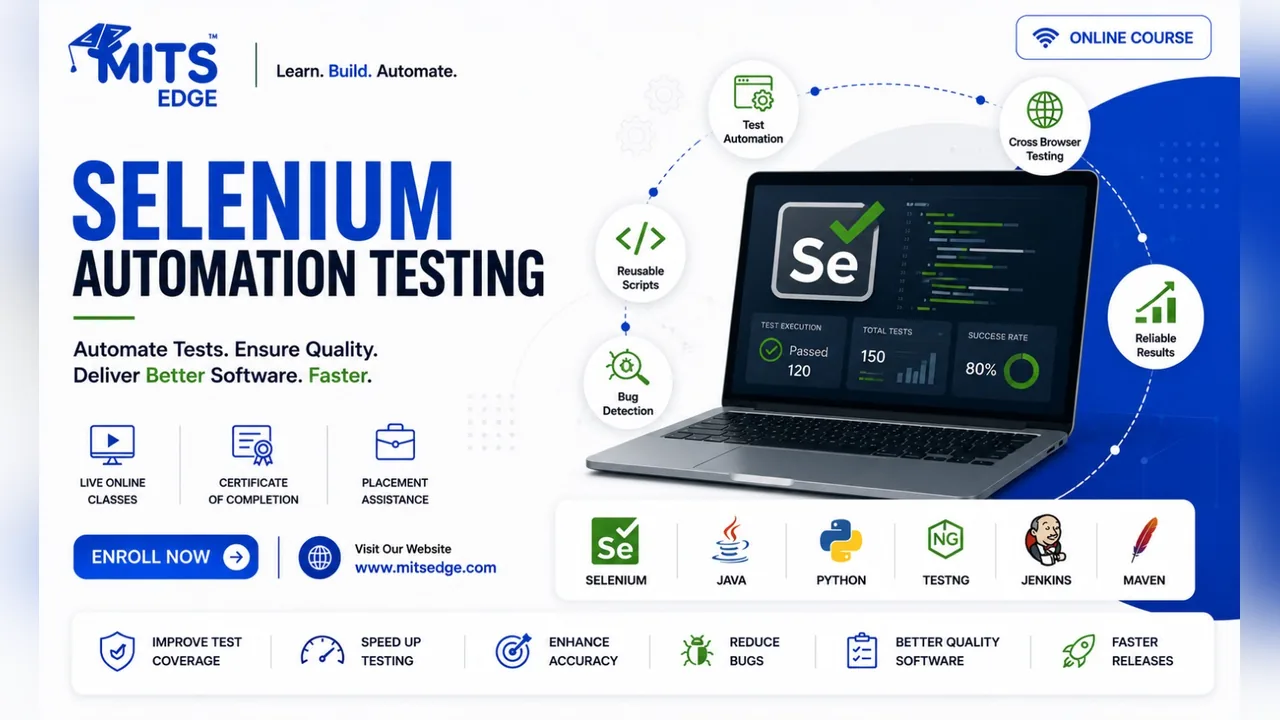
Selenium Automation Testing is an intermediate-level live online course running 8 weeks (54 hrs), priced at $800 USD, taught by instructors in evening and weekend cohorts for learners in the US and Canada, with a certificate of completion.
Learn to automate web application testing with Selenium WebDriver — locators, frameworks, TestNG, reporting and CI integration — and build a maintainable test framework. What you will build: a Page Object test framework for an e-commerce site with data-driven tests and HTML reports. Tools and technologies: Selenium WebDriver, Java, TestNG, Maven, Page Object Model, Git, Jenkins, Extent Reports. Format: 54 hours of live, instructor-led online training over about 8 weeks, in evening and weekend cohorts for learners in the US and Canada, with hands-on labs, recorded sessions and mentor support. Career pathways: QA Automation Engineer, Software Test Engineer (SDET, junior), Test Analyst, QA Engineer. Resume review and interview guidance are available to all learners.
Course Highlights
- 54 hours of live instructor-led training
- Hands-on projects and real-world labs
- Tools: Selenium WebDriver, Java, TestNG
- Certificate of completion
- Career guidance for US & Canada job market
- Recorded sessions and mentor support
Minimum Requirements
- Basic programming (Java preferred); testing basics
- Laptop or desktop with stable internet
Who is this for ?
- Manual testers moving to automation
- Developers learning test automation
- QA graduates building a framework portfolio
Curriculum
Course Curriculum
6 modules · 22 topics0 hours total
- 1Test levels
- 2Java essentials for testers
- 3Maven setup
Industry-Recognized
Certification
Upon successful completion, you receive a certificate of completion for the Selenium Automation Testing program that you can share with employers and add to your LinkedIn profile — a record of the hands-on skills and projects you completed.
- Verifiable ID: Unique credential link for LinkedIn.
- Skill Validation: Proof of hands-on project completion.
- Corporate Branding: CO-branded with your company logo.
Student Reviews
Why learn this online
DevOps sits at the intersection of development and operations, and demand for engineers who can automate builds, deployments, and infrastructure keeps growing as companies ship faster. Learning online with hands-on CI/CD and automation labs builds the pipeline-building portfolio that DevOps hiring actually looks for.
Who this is for
- ✓Developers wanting to move into infrastructure
- ✓Sysadmins adding automation and CI/CD skills
- ✓Cloud engineers deepening their pipeline expertise
Career outcomes
- DevOps Engineer
- Site Reliability Engineer
- Build & Release Engineer
- Automation Engineer
Frequently asked questions
How much does the Selenium Automation Testing course cost?
The Selenium Automation Testing course costs $800 (USD) for 8 Weeks (54 hrs) of live, instructor-led online training. The fee covers live classes, recorded sessions, hands-on projects, mentor support and the certificate of completion.
What projects will I build in Selenium Automation Testing?
You will build a Page Object test framework for an e-commerce site with data-driven tests and HTML reports.
Which tools and technologies does Selenium Automation Testing cover?
Selenium Automation Testing covers Selenium WebDriver, Java, TestNG, Maven, Page Object Model, Git, Jenkins, Extent Reports.
Is the Selenium Automation Testing course online or in person?
The Selenium Automation Testing program is delivered live and online with instructor-led sessions, so you can join from anywhere in the US, Canada, or beyond. Sessions are interactive and recordings are available for review.
How long is the Selenium Automation Testing course?
The Selenium Automation Testing program runs for 8 Weeks (54 hrs). Cohorts are scheduled in the evenings and on weekends to fit around a full-time job.
What level is the Selenium Automation Testing course — is it suitable for beginners?
The Selenium Automation Testing program is pitched at a intermediate level. Some prior familiarity helps, and the curriculum builds toward job-ready skills.
Do I get a certificate after completing Selenium Automation Testing?
Yes — you receive a verifiable certificate of completion for the Selenium Automation Testing program, which you can share with employers and add to your LinkedIn profile.
Does the Selenium Automation Testing course include placement or career support?
Yes. MITS Edge programs include career support — resume reviews, mock interviews, and job-search guidance aligned to the US and Canadian hiring markets.
Do I need any prior experience to join Selenium Automation Testing?
Recommended prerequisites: Basic programming (Java preferred); testing basics; Laptop or desktop with stable internet.
Do I need to be a strong programmer for DevOps?
Scripting ability (Bash, Python) matters more than deep software engineering — DevOps is about automating and reliably operating systems, not building applications.
What tools does a DevOps course typically cover?
Common tools include Git, Docker, Kubernetes, CI/CD platforms like Jenkins or GitHub Actions, and infrastructure-as-code tools like Terraform.
Related Courses
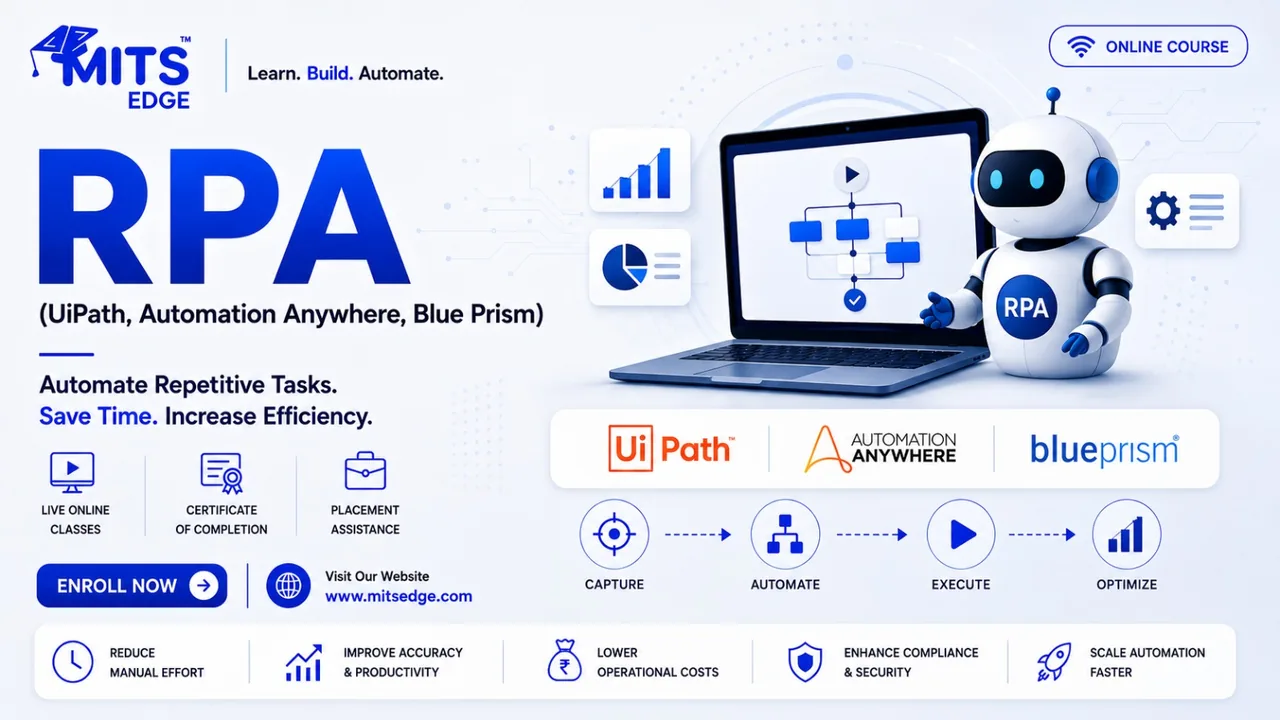
RPA Fundamentals (UiPath, Automation Anywhere, Blue Prism)
A vendor-neutral introduction to robotic process automation, with starter exercises across UiPath, Automation Anywhere and Blue Prism so you can choose the platform to specialise in.
n8n AI Agents & Automation – Essential
Automate real business workflows without heavy coding using n8n — triggers, APIs and AI agents that connect your tools and handle repetitive work.
n8n AI Agents & Automation – Advanced
Build production-grade AI agents and multi-step automations in n8n — tool-calling agents, RAG, human-in-the-loop approvals and robust error handling.

DevOps Fundamentals
Understand the DevOps culture and toolchain end to end — version control, CI/CD, containers, infrastructure as code and monitoring — through guided hands-on labs.